%201.avif)

Dysport or Botox: What's Actually Different, and Which One Is Right for You?
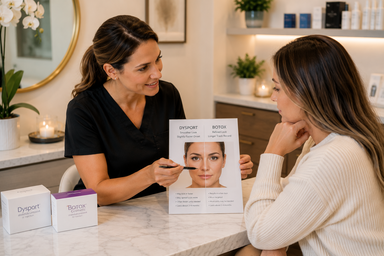
If you've started researching neuromodulator injections, you've probably noticed that Botox isn't the only name that comes up. Dysport shows up almost as often, and the two are frequently mentioned together, which raises a fair question: are they actually different, or is it mostly branding? The honest answer is a little of both. They work in a similar way but have some meaningful differences in how they behave once injected, and those differences can matter depending on your goals.
Updated August 2026
What Do Dysport and Botox Have in Common?
Both Dysport and Botox belong to a category of treatments called neuromodulators. They're both derived from botulinum toxin type A, and both work by temporarily blocking nerve signals to specific facial muscles, which reduces the repetitive movement responsible for dynamic wrinkles. Both are FDA-approved for cosmetic use, both are administered through quick injections, and both are commonly used for the same general areas of the face, including forehead lines, frown lines between the eyebrows, and crow's feet.
So What's Actually Different Between Them?
Molecule Size and Spread
One of the more technical but practical differences is molecule size. Dysport has a smaller molecular structure compared to Botox, which allows it to diffuse slightly more across the treated area. This can make Dysport a good option for larger muscle groups, like the forehead, where broader, more even coverage is helpful.
Onset Time
Many clients report that Dysport tends to show visible results slightly faster than Botox, sometimes within two to three days, compared to Botox's typical three-to-seven-day onset window. This isn't universal for every person, but it's a pattern that comes up often enough to be worth mentioning.
Dosing Units
Dysport and Botox are measured in different units that aren't directly interchangeable. A treatment plan using Dysport will typically involve a different unit count than an equivalent Botox treatment, which is one reason providers calculate dosing carefully based on the specific product being used.
Dilution and Formulation
The two products are formulated slightly differently, which can affect how they behave once injected, including subtle differences in how they settle into the treated muscle over the following days.
Does One Last Longer Than the Other?
Both Dysport and Botox generally last around three to four months, though individual results vary based on metabolism, muscle strength, dosage, and treatment area. Neither has a dramatic, consistent advantage in longevity over the other across the board, so this typically isn't the deciding factor for most people.
Which One Works Better for Certain Areas?
This is where the differences become more relevant in practice. Because of its tendency to spread slightly more, Dysport is often favored for larger, flatter muscle areas like the forehead, where even diffusion helps create a smoother, more natural result. Botox is sometimes preferred for smaller, more precise areas, like around the eyes, where more targeted placement is beneficial. That said, both products are used successfully across all of these areas, and the right choice often comes down to your provider's experience and your own facial anatomy rather than a strict rule.
Does One Hurt More Than the Other?
Both treatments involve a similar injection experience, typically described as a brief pinch. Neither has a meaningful advantage in comfort over the other, and most people tolerate both equally well.
How Do You Decide Between Dysport and Botox?
Consider Your Treatment Area
If you're primarily concerned with forehead lines, Dysport's spreading quality may offer a smoother result. If you're focused on more localized lines, like crow's feet, Botox's precision may be the better fit.
Consider How Quickly You Want to See Results
If you have an event or timeline in mind and want to see change sooner, Dysport's typically faster onset might be appealing.
Consider Your Past Experience
If you've used one product before and were happy with the results, that history is valuable information. Some people also find their body responds slightly differently to one formulation versus the other, which only becomes clear through direct experience.
Trust Your Provider's Recommendation
An experienced injector can assess your facial muscles, the specific lines you're hoping to soften, and your goals, and recommend whichever product is likely to give you the most natural, effective result. This is often more reliable than choosing based on general comparisons alone.
Can You Switch Between Dysport and Botox?
Yes. Many people try one product first and switch to the other for a later treatment, either out of curiosity or because a provider suggests it might suit a particular area better. There's no medical downside to switching between the two as long as your provider adjusts the dosing appropriately.
What Should You Expect During Treatment?
Regardless of which product you choose, the appointment process is nearly identical. A consultation to discuss your goals and facial movement patterns, a quick series of injections, and minimal downtime afterward. Most people return to their normal activities immediately, with only a small chance of mild redness or bruising at the injection sites.
Frequently Asked Questions
Is Dysport cheaper than Botox? Pricing varies by provider and treatment area, and cost differences often come down to how many units are needed for your specific plan rather than a fixed price difference between the two products.
Can I be allergic to one and not the other? It's possible, though uncommon, for someone to tolerate one product better than the other. If you've had a reaction to either in the past, be sure to mention it during your consultation.
Does Dysport spread into areas I don't want treated? When administered by an experienced provider using proper technique and dosing, the spread of Dysport is controlled and intentional, targeting the treatment area without affecting nearby muscles you want left alone.
How do I know which one my provider will recommend? Your provider will typically base the recommendation on your treatment area, the strength of your facial muscles, and your specific goals, which is best determined during an in-person consultation.
Can Dysport and Botox be used in different areas during the same appointment? This isn't common practice, since most providers prefer to use one product per session for consistency, but your provider can walk you through the reasoning for your specific plan.
The Verdict? There's No Wrong Answer, Just a Better Fit
Dysport and Botox aren't rivals so much as two well-established tools that accomplish a similar goal in slightly different ways. The best choice comes down to your treatment area, your priorities around timing, and your provider's clinical judgment.
Our team at Glotologi Med Spa offers both options for clients throughout Bentonville, Arkansas and can help you decide which one lines up best with your goals. Visit our neuromodulator services page or schedule a consultation to talk through your options. You can also read more about fine lines and wrinkles on our skin concerns page.